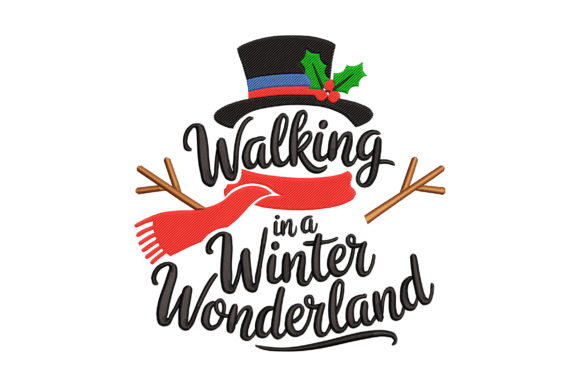
Walking in a Winter Wonderland
A Professional Embroidery Designer’s Review for Small Business Use
As an embroidery designer who’s digitized and stitched over 2,000 commercial projects—from café aprons to boutique tote bags—I approach every new design with two questions: Will it translate cleanly on real fabric? and Will it strengthen a small business’s brand—not distract from it? That’s why I took Walking in a Winter Wonderland straight to the hoop, not just as decoration, but as functional brand asset. The title alone evokes warmth, nostalgia, and seasonal charm—but charm doesn’t stitch well if it isn’t engineered for business.
First Impression: Classic Joy, Not Just Holiday Cliché
At first glance, Walking in a Winter Wonderland reads as elegant yet approachable—not overly ornate, not cartoonish. It leans into timeless Christmas storytelling without leaning on tired tropes like reindeer silhouettes or glittery snowflakes. That’s critical for small businesses that want festive appeal without sacrificing sophistication. A florist adding this to linen aprons? It feels curated. A pet brand stitching it onto bandanas? It reads as gentle and joyful—not kitschy. That balance makes Walking in a Winter Wonderland unusually versatile across handmade product categories.
Where It Shines in Real Business Applications
- Embroidered patches: Works beautifully at 2.5"–3.5" height—clean outlines hold up, and the implied motion (walking, drifting snow) adds subtle dynamism to sew-on or iron-on patches for staff jackets or gift packaging.
- Apron embroidery: Ideal for left-chest placement on cotton or canvas aprons. Its horizontal flow complements apron pockets and avoids visual crowding near waistbands or ties.
- Cap embroidery: Performs well on structured front panels when scaled to 2" width—just avoid ultra-low-profile caps where curvature distorts delicate line work.
- Tote bag design: Stitches crisply on medium-weight canvas and non-woven polypropylene. The rhythm of the phrase lends itself to centered, balanced placement above handles—no extra graphics needed.
- Staff uniforms & custom apparel: Reads clearly on work shirts and puffer vests, especially when paired with tonal thread (e.g., heather grey thread on charcoal fabric). Reinforces seasonal hospitality without shouting.
- Boutique merchandise & Etsy branding: Adds instant narrative value to handmade product labels, gift tags, and packaging accents—especially when used alongside other cohesive design assets like monogrammed initials or minimalist snow motifs.
Where Caution Is Required
Walking in a Winter Wonderland is not a one-size-fits-all embroidery file. Its charm lives in its detail—and detail demands attention. Avoid using it below 1.75" in height unless you’ve verified legibility at that scale. Tiny lettering (especially “wonderland”) can blur on dense fabrics or with low-contrast thread. Also, steer clear of high-stitch-density interpretations on textured surfaces like fleece-lined caps or bouclé tote bags—unless paired with cutaway stabilizer and tested first.
Dark uniforms? Yes—but only with high-contrast thread (white, silver, or bright icy blue). Light-colored garments? Deep navy or forest green thread creates premium contrast without looking flat. And always test on your actual fabric: what looks crisp on twill may feather on slubbed linen or stretch on performance knit.
How It Shapes Brand Identity & Customer Trust
For small businesses, consistency is credibility. When Walking in a Winter Wonderland appears across staff aprons, customer tote bags, and holiday gift boxes, it signals intention—not just decoration. Customers subconsciously register that level of cohesion as professionalism. They trust a bakery that uses the same refined embroidery language on its counter aprons and take-home cookie bags more than one that swaps fonts and styles each season.
This design also elevates perceived product value. Handmade goods—like ceramic mugs or soy candles—gain emotional resonance when paired with thoughtfully embroidered packaging accents. It tells customers: This wasn’t mass-produced. This was chosen, stitched, and cared for. That’s gold for Etsy sellers, local studios, and creative brands building community loyalty.
Practical Designer Notes Before You Stitch
- Test in black and white first. Confirm readability without color bias—especially for client approvals.
- Check patch-size viability. Resize to your smallest intended use (e.g., 2" x 1") and verify spacing between letters and snow elements remains open and clean.
- Review thread color contrast. Avoid matching thread too closely to base fabric—subtle contrast improves longevity and visual impact.
- Inspect spacing and underlay. Tight kerning or thin connecting stitches may need reinforcement for commercial washing durability.
- Confirm hoop size compatibility. Ensure your frame fits the widest version you’ll use—especially for cap fronts or sleeve placements.
- Test on real fabric + stabilizer combo. What works on denim may pucker on chambray. Always stitch a sample before bulk production.
- Create a printable mockup. Show clients how Walking in a Winter Wonderland integrates with their existing logo, typography, and brand colors—before committing thread or time.
- Compare beside other design assets. Does it sit comfortably next to your shop name, monogram, or seasonal icon set—or does it visually compete?
- Verify commercial licensing. Since this is a digital embroidery file intended for small business merch and branded patch use, confirm usage rights cover resale, client projects, and physical product labeling.
Ultimately, Walking in a Winter Wonderland isn’t just another Christmas embroidery design—it’s a quiet brand amplifier. When executed with care, it brings seasonal warmth without compromising clarity, craftsmanship, or commercial intent. For cafés, boutiques, makers, and local shops, it’s not about adding holiday flair. It’s about stitching intention—into every apron, cap, and tote bag your customers carry long after the snow melts.