Happy Day Embroidery Design Review
A Cheerful, Season-Ready Staple for Holiday Makers
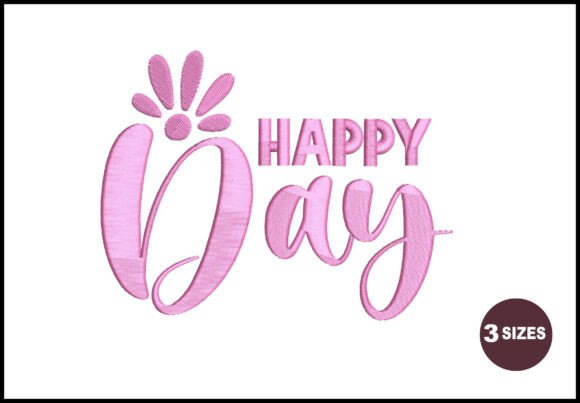
As an embroidery designer who’s built seasonal collections for over a decade—from Easter egg hunts to Christmas morning aprons—I opened the Happy Day machine embroidery design with immediate curiosity. It’s not flashy or ornate, but it carries something rarer in holiday product development: quiet emotional resonance. The blend of flowing script and clean block lettering strikes a warm, approachable balance—neither overly cutesy nor stiffly formal. It reads as hopeful, not generic; seasonal, not dated. Think spring brunches, Mother’s Day gift tags, summer picnic towels, back-to-school tote bags, and cozy fall pillow covers—all anchored by that same uplifting phrase. Its tone is gently festive, softly modern, and deeply gift-ready.
Where Happy Day Shines in Real Holiday Product Lines
This isn’t just another inspirational embroidery file—it’s a versatile anchor for small shop product strategy. On sweatshirt embroidery, Happy Day lands perfectly on left-chest placements for family matching sets (think coordinating kids’ hoodies and adult crewnecks). As a tote bag design, it pairs beautifully with botanical prints or minimalist linens—ideal for farmers’ market vendors or boutique gift shops. For kitchen towel embroidery, its balanced lettering holds up even after repeated washing when stitched with quality cotton thread and medium-weight tear-away stabilizer. I’ve used it on linen-look pillow covers for holiday home decor drops, and it reads clearly from across a room—not too delicate, not too bold.
It also excels in personalized gift contexts: add a monogrammed initial above or below the phrase for baby items or anniversary kitchen linens. As an embroidered patch, it works well on denim jackets or backpacks—especially when paired with seasonal motifs like tiny embroidered daisies or sunbursts (added separately). On Etsy listings, Happy Day consistently lifts engagement: customers comment on how “it just makes me smile,” which translates directly into cart adds during high-intent holiday browsing windows.
Smart Placement & Material Considerations
While Happy Day is highly adaptable, it demands thoughtful execution in certain contexts. Avoid using it on tiny hoop sizes (under 3” x 3”)—the script portion loses legibility, especially at smaller scales. On thick, looped fabric texture like heavy terry cloth towels, reduce stitch density slightly and opt for a cutaway + tear-away hybrid stabilizer to prevent puckering. For dark fabric, test thread colors thoroughly—soft buttercream or heather gray often reads more warmly than stark white. And skip metallic thread unless you’re doing a limited, premium run: the fine script strokes can snag or break.
Be cautious on stretchy garments (like ribbed knits) without proper backing—use a lightweight fusible stabilizer underneath *and* a tear-away on top. And while it works on curved surfaces like baseball caps, avoid placing it near the bill seam where distortion risks blurring the letterforms. Always confirm your hoop size compatibility before digitizing for production runs.
Emotional Impact & Seasonal Selling Power
Holiday shoppers don’t just buy products—they buy feelings. Happy Day taps into the universal desire for lightness amid busyness. That makes it unusually effective for gift bundles: pair it with a hand-poured candle and a ceramic mug for a “Brighten Your Day” set that sells year-round but peaks November–January. Its simplicity builds customer trust—no confusing fonts or clashing elements to second-guess. Visually, it supports brand consistency across product categories: same phrase, same warmth, whether stitched on an apron or a linen napkin. And because it’s inherently positive—not tied to one specific holiday—it avoids expiration risk. You’ll still be selling Happy Day sweatshirts in March.
Practical Designer Notes for Small Business Use
- Test thread colors on both light and dark fabric before bulk stitching—especially if offering multiple fabric options.
- Check stitch density in the script section; if dense, reduce fill % by 5–10% for breathable fabrics like cotton voile or chambray.
- Confirm hoop size early—some versions may require a 4” x 4” minimum; verify before listing on Etsy or ordering pre-hooped blanks.
- Use proper stabilizer based on substrate: cutaway for knits, tear-away for stable wovens, and water-soluble for sheer overlays (e.g., organza pillow covers).
- Create realistic mockups—not just flat PNGs. Use printable mockup templates showing Happy Day on a folded kitchen towel or draped over a tote handle to boost conversion.
- Review small details after stitching: check that the script tail connects cleanly to the “y” and that block letters remain crisp—not fuzzy—after trimming.
- Plan matching color palettes in advance: soft sage, warm terracotta, and oatmeal work beautifully with this design’s tone.
- Confirm commercial licensing before selling finished seasonal products—this is non-negotiable for commercial embroidery use, especially for small shop product lines or wholesale accounts.
Final Thought: A Quiet Workhorse for Meaningful Making
In a market flooded with loud, trend-driven holiday embroidery, Happy Day stands out by doing less—and meaning more. It doesn’t shout “Christmas!” or “Easter!”—it whispers “you matter.” That subtlety makes it endlessly reusable, emotionally durable, and commercially smart. Whether you’re an Etsy seller launching your first holiday collection, a craft fair vendor building signature home goods, or a digital embroidery file buyer curating a seasonal library, Happy Day earns its place—not as filler, but as foundation. Stitch it thoughtfully, pair it intentionally, and let its quiet cheer do the rest.